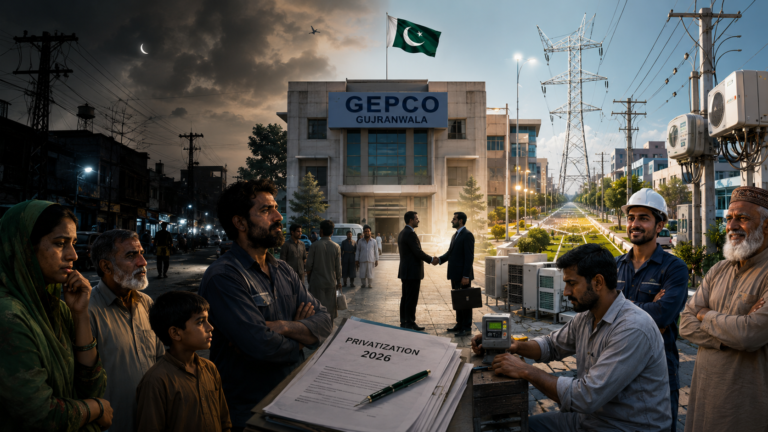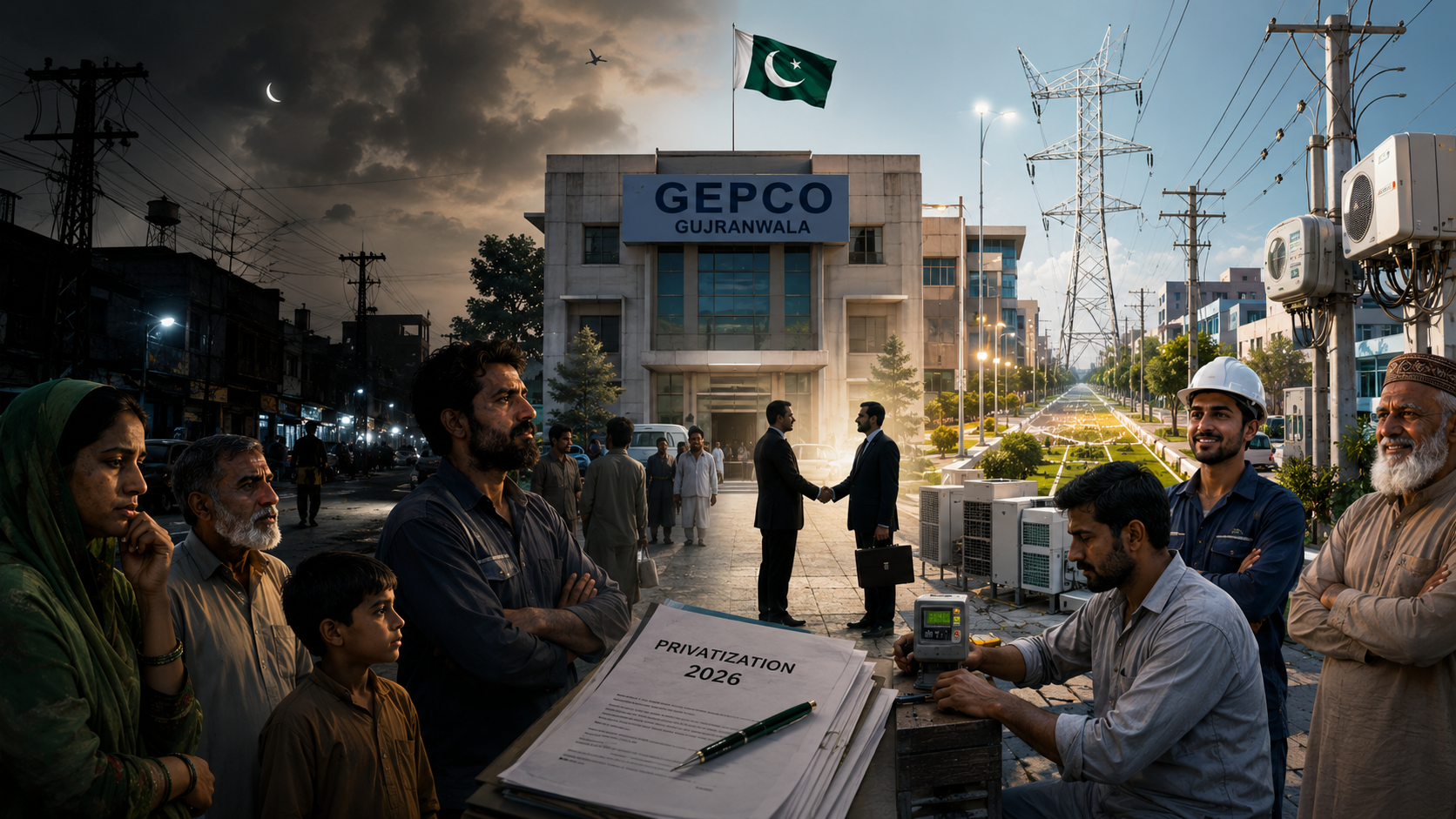
You pay your bill on time, but the lights still go out at the worst possible moment — maybe during a factory shift, maybe when your kids are studying for exams. It’s a frustration shared by millions across the region.
So when news broke that the government is officially moving to privatise GEPCO — the Gujranwala Electric Power Company — the reaction was predictably mixed. Some people saw it as long-overdue relief. Public is worried about after privatising what will happen.
Let’s share as points.
What is Actually Happening
In October 2025 an approval of 3 companies to be privatised which are FESCO (Faisalabad), GEPCO (Gujranwala), and IESCO (Islamabad). After this the recommendations went to the Cabinet Committee on Privatisation which gave its formal approval in May 2026.
By May 19, 2026 the govt invites EOIs from local and international investors. Deals offered and with shares and full management control. This isn’t a partial arrangement or a management contract — whoever buys in gets to run the show.
The deadline decided to submit of these of Interest for GEPCO is August 6, 2026. A non-refundable processing fee of Rs 1.4 million is required from each interested party.
PM Shehbaz Sharif has personally directed officials to speed up the process, with investor roadshows planned in Pakistan, Saudi Arabia, Turkey, and China. The message from Islamabad is clear this privatisation is happening, and fast.
Why GEPCO? Why Now?
The honest answer is debt. Pakistan’s power sector has been bleeding money for years. Distribution companies like GEPCO have accumulated massive losses, and that burden ultimately falls on the national budget — which means the taxpayer.
GEPCO gives their services in Gujranwala, Narowal, Hafizabad, and Sialkot. Millions of consumers. Dozens of industrial units.
The government’s argument is straightforward: private ownership will force efficiency. When profit is at stake, there’s a sharper incentive to reduce line losses, fix technical faults faster, and actually collect what’s owed. Whether that plays out the way officials hope is a different question — but the logic behind it isn’t hard to follow.
What Gujranwala’s Residents Should Know
For the average household, the most pressing question isn’t about shareholding structures or investor roadshows. It’s simpler: will my electricity become more expensive, and will the service actually get better?
On the cost side, the government has said the new owners will have to work within NEPRA’s regulatory framework. Tariff changes won’t happen overnight — the existing tariff structure, multi-year tariff regime, and business model will all be reviewed as part of the privatisation process. The Privatisation Commission has explicitly stated it will work with stakeholders to refine these frameworks before the transfer happens.
On the service side, that’s where optimism has at least some foundation. Private distribution companies elsewhere in the world — and even in Pakistan’s telecom sector — have shown that competition and accountability can drive real improvements. Better billing, faster fault response, reduced outages. Whether this holds true for electricity distribution is less certain, but it’s not an unreasonable expectation.
The Concerns Are Real Too
It would be dishonest to only present the rosy picture. There are legitimate worries.
Electricity isn’t like a mobile network you can switch from if you don’t like the service. It’s a natural monopoly. Once GEPCO is in private hands, consumers in Gujranwala won’t have the option to go elsewhere. That makes strong, independent regulation absolutely critical — and Pakistan’s regulatory track record in this sector has been uneven at best.
Workers at GEPCO are also understandably anxious. because it can cut their jobs because govt not clarify about employment.
There’s also the question of which type of investor ends up buying in. A serious infrastructure operator with a long-term horizon is a very different proposition from a short-term financial buyer looking to extract value quickly. The government says the process will be transparent and follow international best practices — but the devil, as always, will be in the details of the final transaction.
What Comes Next
For Gujranwala, the coming months will be important to watch. Will the local industrial sector — one of the largest concentrations of manufacturing in Punjab — weigh in on the terms being set? Will consumers have any voice in how the regulatory framework is structured? These are the questions worth following closely.
This city has seen enough promises about electricity improvement come and go. What matters now isn’t the announcement — it’s what actually changes on the ground.
About the Author